
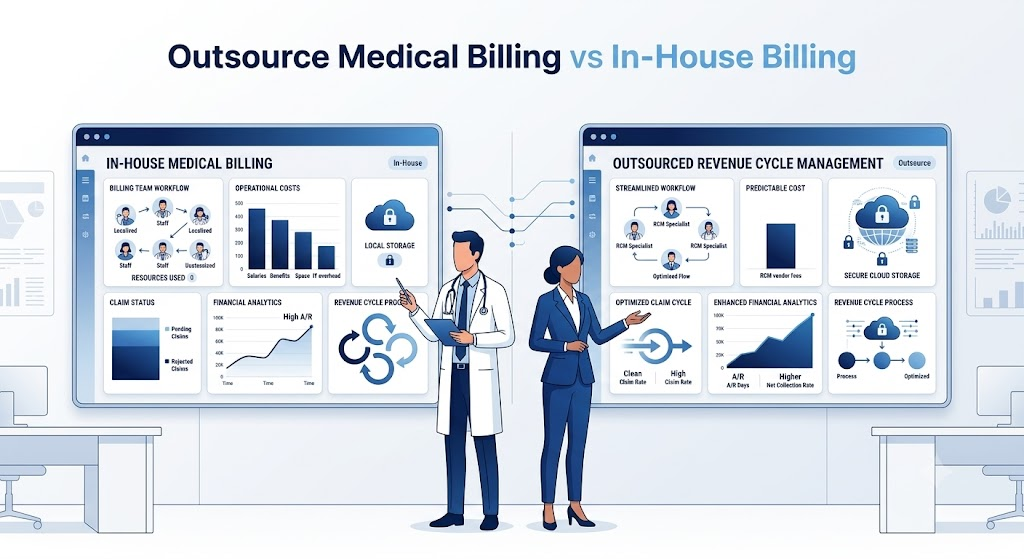
Executive Summary
As payer requirements become more complex and administrative burdens continue to grow, many healthcare practices are choosing to outsource medical billing. Deciding between outsourcing or maintaining an in-house billing department is a pivotal choice that can significantly impact your revenue cycle and long-term profitability.
Understanding Today’s Revenue Cycle Challenges
Physicians and practice owners frequently wonder whether they should outsource medical billing or continue managing it internally. Specifically, this question is driven by several factors, including increasing payer complexity, staffing shortages, stricter reimbursement requirements, and a growing administrative burden. Moreover, these challenges are intensifying each year.
A universal answer doesn’t exist. Instead, the right decision depends on your practice’s size, specialty, growth plans, staffing stability, financial performance, and operational maturity.
Ultimately, each practice must evaluate its unique circumstances to make the best decision for their specific situation.
Throughout this guide, we will compare outsourced medical billing and in-house billing across several critical dimensions. For example, our analysis examines cost, return on investment (ROI), operational control, staffing, technology, compliance, scalability, and long-term profitability.
In addition, we explore real-world scenarios that clearly illustrate these core differences. By the end, you will easily understand how to evaluate your current revenue cycle, identify warning signs, and determine which model is best suited for your unique practice.
Should you outsource medical billing or keep it in-house?
Why Reimbursement Has Become More Complex
Healthcare reimbursement has changed dramatically over the past decade. For instance, insurance companies now use sophisticated automated systems that review claims within seconds. As a result, minor documentation inconsistencies that might have slipped through years ago are now identified almost instantly. Similarly, practices are expected to submit cleaner claims, comply with evolving payer rules, and collect more patient responsibility than ever before. In fact, the pressure on medical practices has never been greater. Furthermore, the complexity of payer requirements continues to expand each year.
Consequently, healthcare organizations face rising labor costs, difficulty hiring experienced billing staff, frequent payer policy changes, more prior authorization requirements, increasing patient financial responsibility, ongoing technology investments, and greater compliance expectations. In short, the result is that many practices are finding themselves working harder while collecting less. Meanwhile, patient expectations and regulatory demands continue to rise.
For many independent practices, keeping pace has become increasingly difficult. Therefore, more healthcare organizations are choosing to outsource medical billing to improve collections, reduce administrative costs, and strengthen revenue cycle performance.
Article Overview & Guide Blueprint
Reading Time: 11–13 Minutes
Best For
• Practice Owners
• Physicians
• Office Managers
• Practice Administrators
• Healthcare Executives
• Multi-Location Practice Operators
You’ll Learn
✔ Real baseline numbers on whether outsourcing actually saves money
✔ Uncovering the hidden costs most practices never calculate accurately
✔ Key operational ways staffing shortages negatively affect collections
✔ Understanding exactly when outsourcing delivers the highest financial ROI
✔ Why keeping billing inside the practice can still make sense for some
✔ Practical steps to evaluate your billing department objectively
✔ A simple decision framework used by successful practices
Table of Contents
- Why More Practices Outsource Medical Billing in 2026
- Understanding Today’s Revenue Cycle Challenges
- What Is In-House Medical Billing?
- What Is Outsourced Medical Billing?
- The Real Cost of In-House Billing Internally
- Hidden Expenses Most Practices Ignore
- Outsourced Medical Billing vs In-House Medical Billing
- Calculating ROI for Outsourced Medical Billing
- Decision Matrix: Should You Outsource Medical Billing?
- Frequently Asked Questions
- Final Recommendations
More healthcare organizations outsource medical billing to improve collections, reduce administrative costs, and strengthen revenue cycle performance.
The Healthcare Business Decision Most Practices Eventually Face
Every healthcare practice reaches a point where leadership asks a difficult question.
“Are we spending too much time managing our billing instead of growing our practice?”
Sometimes that question arises because reimbursements are slowing down.
In other instances, the shift is driven unexpectedly by sudden staff turnover.
Furthermore, it frequently stems from the pure frustration of dealing with increasing payer requirements, mounting denials, or aging accounts receivable.
Whatever the reason, the underlying issue is the same.
Your revenue cycle has become a business strategy—not just an administrative process.
Medical billing is no longer limited to submitting claims and waiting for insurance payments.
Today’s revenue cycle demands expertise in payer rules, coding updates, credentialing requirements, prior authorizations, denial prevention, compliance, analytics, reporting, and
workflow optimization.
Accurate coding plays a significant role in preventing claim denials, which is why many Revenue Cycle Management companies employ certified coding professionals who stay current with industry guidance published by organizations such as the AAPC.
For many independent practices, keeping pace has become increasingly difficult.
ClaimsMed Insight
Across the healthcare practices we support, the biggest revenue problems rarely begin with claim submission. Most revenue leakage starts much earlier—with inaccurate patient registration, missed eligibility verification, incomplete documentation, or credentialing delays.
Why More Practices Outsource Medical Billing in 2026
Healthcare reimbursement has changed dramatically over the past decade. Indeed, medical providers continue to navigate evolving Medicare and payer requirements published by the Centers for Medicare & Medicaid Services (CMS), making it essential to maintain accurate billing and compliance processes. As a result, insurance companies now use sophisticated automated systems that review claims within seconds.
The Impact of Automated Rules
Consequently, minor documentation inconsistencies that might have slipped through years ago are now identified almost instantly. Beyond this automated scrutiny, modern practices are expected to submit cleaner claims, comply with evolving payer rules, and collect far more patient responsibility than ever before.
Operational Burdens on Providers
Because the financial pressure doesn’t stop there, independent healthcare organizations simultaneously face:
- Rising labor costs
- Difficulty hiring experienced billing staff
- Frequent payer policy changes
- More prior authorization requirements
- Increasing patient financial responsibility
- Ongoing technology investments
- Greater compliance expectations
As a direct result of these challenges, many practices are finding themselves working harder while collecting significantly less revenue.
Practice Owner Tip
If your practice is consistently busy but monthly collections remain flat, the issue may not be patient volume.
It’s often a sign that your revenue cycle needs attention.
Why Practices Outsource Medical Billing for Better Revenue Cycle Management
Many practice owners still think of billing as something that happens after the patient leaves. In reality, your revenue cycle begins long before a claim is submitted because every step directly influences reimbursement.
Core Steps in the Revenue Cycle
To illustrate this, a successful revenue cycle must include:
- Appointment scheduling
- Insurance verification
- Eligibility confirmation
- Patient registration
- Provider credentialing
- Prior authorization
- Medical documentation
- Coding accuracy
- Claim submission
- Payment posting
- Denial management
- Appeals
- Patient collections
- Financial reporting
Ultimately, weakness in any one of these areas creates downstream problems that reduce your net revenue. That’s exactly why evaluating your billing model requires looking far beyond payroll costs. Instead, it requires understanding the entire financial ecosystem of your practice. Furthermore, choosing to outsource medical billing provides immediate access to experienced billing specialists without expanding in-house staffing.
What Is In-House Medical Billing?

In-house medical billing means your practice manages every aspect of the revenue cycle internally using your own employees and technology. Specifically, depending on your organization, that could involve a single biller or an entire department responsible for handling claims from start to finish.
Internal Billing Operations
Typically, your team’s routine responsibilities include:
- Insurance eligibility verification
- Charge entry
- Medical coding
- Claim submission
- Payment posting
- Accounts receivable follow-up
- Patient billing
- Denial investigation
- Appeals
- Revenue reporting
Furthermore, many physicians appreciate the visibility that comes with an internal team because questions are answered quickly. Similarly, documentation issues can often be resolved immediately since staff become familiar with provider preferences and office workflows.
Consequently, when managed effectively, an experienced in-house department can become a valuable operational asset. However, maintaining that level of performance requires continuous investment in people, technology, education, and compliance.
Bottom Line
An in-house billing department offers greater operational control—but maintaining high performance requires ongoing investment far beyond employee salaries.
What Is Outsourced Medical Billing?
Outsourced medical billing involves partnering with a specialized Revenue Cycle Management (RCM) company to manage some or all of your billing operations. Instead of expanding your internal billing department, you gain access to dedicated specialists whose primary focus is maximizing collections and improving financial performance.
Managed RCM Responsibilities
Depending on the engagement, an outsourced partner may manage:
- Claim submission
- Coding review
- Clearinghouse management
- Payment posting
- Denial management
- Appeals
- Accounts receivable recovery
- Credentialing coordination
- Revenue reporting
- Payer communication
Clearly, the objective extends far beyond reducing administrative workload. Consequently, a strong revenue cycle partner should actively help practices:
- Increase clean claim rates
- Reduce denial percentages
- Accelerate reimbursements
- Improve cash flow
- Shorten Days in Accounts Receivable
- Strengthen reporting visibility
- Support sustainable growth
Therefore, rather than functioning as an outside vendor, the best billing partners ultimately become a true extension of your administrative team.
Quick Win
Outsourcing shouldn’t eliminate visibility into your revenue cycle. It should improve it. Modern RCM partners provide detailed reporting, KPI dashboards, denial trend analysis, and dedicated account management that often exceeds what many practices can generate internally.
In-House vs. Decision to Outsource Medical Billing: A High-Level Comparison
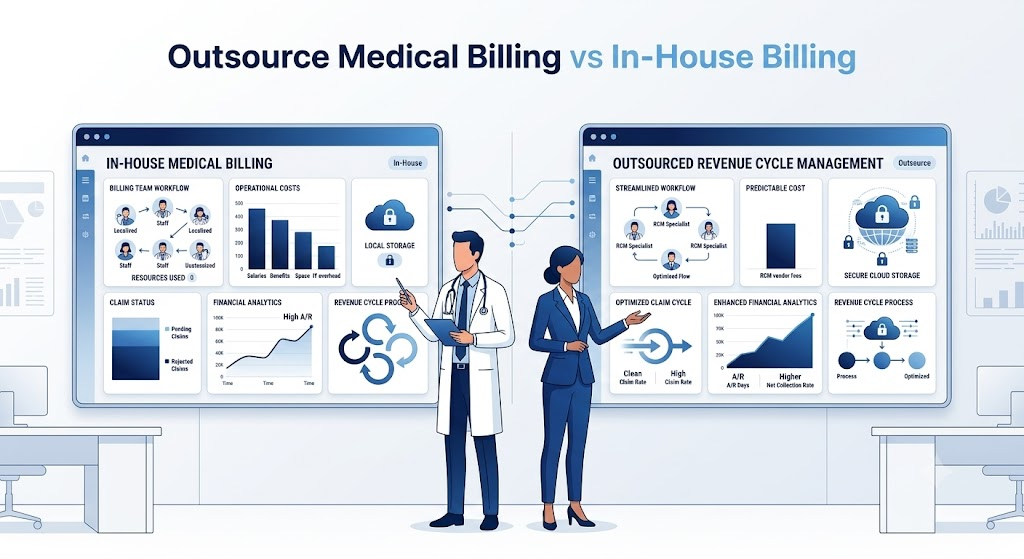
| Category | In-House Billing | Outsourced Medical Billing |
| Staffing | Internal employees | Dedicated RCM specialists |
| Payroll Responsibility | Practice | Billing partner |
| Software Investment | Practice | Often included |
| Scalability | Limited by hiring | Easily scalable |
| Compliance Monitoring | Internal | Shared with experienced specialists |
| Reporting | Depends on software | Advanced dashboards commonly available |
| Business Continuity | Staff dependent | Team-based support |
| Operational Control | High | Collaborative oversight |
| Technology Updates | Practice responsibility | Usually managed by partner |
Notice that neither model is automatically superior.
Success depends on execution.
The real question isn’t:
“Which model costs less?”
It’s:
“Which model helps my practice collect more revenue while creating fewer operational challenges?”
Practice Scenario
A growing three-provider family medicine practice hires a new physician, expands appointment availability, and increases patient volume by nearly 25%.
Patient visits rise exactly as planned.
Collections don’t.
Instead, billing delays begin appearing because the existing billing staff can’t absorb the additional workload.
Claims often wait several days before submission. Consequently, eligibility verification becomes inconsistent, and as a result, accounts receivable quickly begins climbing.Initially, leadership believes the problem stems from low reimbursement rates. However, after reviewing the data, they discover the real issue was operational capacity because their clinical growth had completely outpaced their revenue cycle infrastructure.
Situations like this are becoming increasingly common across independent healthcare practices.
Bottom Line
Practice growth doesn’t automatically translate into revenue growth.
Your billing infrastructure must scale alongside your patient volume.
The True Cost Before You Outsource Medical Billing

One of the biggest misconceptions in healthcare is that in-house billing is automatically less expensive than outsourcing.
On paper, it often appears that way.
A practice owner compares an employee’s salary against an outsourcing proposal and concludes that keeping billing internal is the more economical option.
Unfortunately, that’s rarely the complete financial picture.
The actual cost of an internal billing department extends far beyond payroll.
When hidden operational expenses are included, many practices discover they’re investing significantly more than they realized. Many providers eventually outsource medical billing after calculating the ongoing expenses of hiring, training, and retaining billing staff.
Analyzing Loaded Labor Overhead
Payroll Is Only the Beginning
Furthermore, hiring an experienced medical biller involves much more than offering a competitive salary.
Additional costs often include:
• Payroll taxes
• Health insurance
• Retirement contributions
• Paid time off
• Sick leave
• Workers’ compensation
• Recruiting fees
• Background checks
• Training and onboarding
• Continuing education
• Overtime
• Performance management
These expenses continue whether claim volume increases or decreases.
For growing practices, adding providers often means adding additional billing staff—creating another cycle of hiring, training, and retention.
Practice Owner Tip
Don’t compare outsourcing fees to employee salaries alone.
Compare them to your fully loaded labor cost, including benefits, turnover, software, recruiting, and management time.
The Cost Nobody Budgets For: Employee Turnover
Healthcare staffing shortages continue to affect nearly every specialty.
Medical billing professionals are no exception.
When an experienced biller resigns, the financial impact extends well beyond replacing a single employee.
During the transition, practices often experience:
• Slower claim submission
• Delayed payment posting
• Increased claim denials
• Aging Accounts Receivable
• Higher write-offs
• Increased physician interruptions
• Greater stress on remaining staff
Even after hiring a replacement, productivity rarely returns immediately.
Every new employee requires time to learn payer rules, specialty workflows, practice policies, and software systems.
Revenue Tip
Across many practices we support, billing performance often declines weeks before leadership realizes there’s a problem. Cash flow usually reflects operational issues long after they begin.
Technology Is No Longer Optional
Modern medical billing heavily depends on technology. For this reason, without the right tools, even experienced staff spend valuable time performing tasks that could be easily automated.
Most practices invest in multiple systems, including:
• Practice Management Software
• Electronic Health Records (EHR)
• Clearinghouse services
• Coding software
• Eligibility verification tools
• Claim scrubbing software
• Payment posting solutions
• Analytics dashboards
• Secure document management
• Cybersecurity protection
Each subscription adds recurring expenses.
Many also require implementation, training, maintenance, and ongoing support.
Technology should improve efficiency—not create additional administrative work.
Bottom Line
Modern billing isn’t powered by people alone.
It’s powered by experienced people using efficient technology.
Compliance Never Stops Changing
Healthcare billing is one of the most heavily regulated administrative functions in medicine.
Practices must continuously adapt to:
• CPT updates
• ICD-10 revisions
• HCPCS changes
• Medicare policy updates
• Commercial payer requirements
• State Medicaid changes
• HIPAA regulations
• Prior authorization reforms
• Documentation requirements
Billing partners should follow the security standards established under the HIPAA Privacy and Security Rules to protect patient information and maintain compliance.
Missing a policy update doesn’t simply create administrative inconvenience.
It creates denied claims.
Staying compliant requires ongoing education—not occasional training.
Practice Owner Tip
If your billing department only receives formal education once a year, your practice may already be behind current payer requirements.
The Hidden Costs Most Practices Never Measure
Some expenses do not appear on traditional financial statements. Instead, they are simply accepted as a standard part of doing business. Yet, these hidden operational costs quietly reduce your overall profitability every single month.
Measuring Unseen Billing Factors
To illustrate this problem, let’s analyze some of the biggest real-world examples below.
Lost Revenue from Delayed Claims
Crucially, revenue doesn’t begin when a claim is paid. Instead, it actually begins the exact moment a clean claim is submitted. Therefore, every unnecessary delay inevitably slows down your cash flow.
Whether caused by staffing shortages, incomplete documentation, or manual workflows, delayed submissions postpone reimbursement and increase financial uncertainty.
Claims That Never Get Appealed
Not every denied claim gets corrected.
Some remain unresolved because staff simply don’t have time.
Others fall outside timely filing limits before anyone notices.
Over time, these “silent write-offs” become one of the largest sources of preventable revenue leakage.
Leadership Time
Practice owners rarely calculate the value of their own time.
Yet many spend hours each week discussing:
• Billing questions
• Insurance follow-up
• Denial reports
• Staffing issues
• Payment delays
• Software problems
Those hours could be invested in:
• Growing the practice
• Recruiting providers
• Improving patient experience
• Expanding services
Leadership attention has real financial value.
Opportunity Cost
Administrative staff constantly pulled into billing issues spend less time supporting patients.
Physicians interrupted with documentation questions see fewer patients.
Managers focused on operational fires have less time to improve systems.
These opportunity costs rarely appear on reports, yet they significantly affect long-term growth.
Executive Insight
Revenue cycle performance isn’t determined solely by how many claims are submitted.
It’s determined by how efficiently every step—from scheduling through final payment—works together.
When Should You Outsource Medical Billing?
Outsourcing isn’t the right decision for every organization.
However, certain warning signs consistently indicate that practices should seriously evaluate their current billing model.
1. Your Claim Denials Continue Increasing
High denial rates often indicate deeper operational issues involving:
- Registration accuracy
- Payer eligibility verification
- Coding errors
- Incomplete medical documentation
- Prior authorization oversights
- Basic claim edits
Unless you run a dedicated root-cause analysis, your practice will likely continue fixing surface-level symptoms instead of addressing the real operational bottlenecks.
Bottom Line
If your denial rate continues climbing despite working harder, the issue may be your workflow—not your effort.
2. Accounts Receivable Continues Growing
Healthy revenue cycles don’t simply generate revenue.
They generate predictable cash flow.
Typically, the primary warning signs include:
- Growing balances over 60 days
- Increasing balances over 90 days
- Slow payment posting
- Limited follow-up activity
- Inconsistent appeals
As a result, longer payment cycles increase financial pressure while simultaneously reducing your final collection probability.
Practice Owner Tip
Days in Accounts Receivable is one of the simplest indicators of billing performance.
Monitor it monthly—not quarterly.
3. Billing Staff Turnover Is Becoming Routine
Every resignation introduces uncertainty.
The practice loses institutional knowledge while remaining employees absorb additional responsibilities.
Eventually, claim quality suffers.
Many growing practices discover that replacing experienced billing professionals has become more difficult than retaining them.
4. You’re Opening New Locations
Growth creates administrative complexity
.
Each new location increases:
• Claim volume
• Provider credentialing
• Insurance enrollments
• Reporting
• Patient communications
• Accounts Receivable
Your billing infrastructure must scale with your practice.
Otherwise, growth begins creating bottlenecks.
5. Leadership Fatigue: Knowing When to Outsource Medical Billing
Ask yourself one question.
How many hours did your leadership team spend discussing billing problems last month?
If the answer surprises you, your revenue cycle may be consuming resources that should be invested elsewhere.
Physicians should focus on patient care. Meanwhile, managers need to prioritize daily operations, and ultimately, owners must focus on long-term strategy.
When leadership becomes the billing department’s problem solver, growth slows.
When Keeping Billing In-House Still Makes Sense
Outsourcing isn’t automatically the better choice.
Some organizations already operate highly efficient internal billing departments.
In general, practices may benefit from staying in-house if they consistently demonstrate:
- Clean claim rates above 95%
- Low employee turnover
- Experienced certified coders
- Strong payer relationships
- Stable collections
- Modern technology
- Comprehensive reporting
- Continuous compliance education
Furthermore, large multi-specialty organizations often possess the infrastructure necessary to support sophisticated internal revenue cycle departments. Therefore, if performance remains strong, maintaining internal control can easily continue delivering excellent results.
ClaimsMed Insight
Outsourcing isn’t a rescue strategy.
It’s a growth strategy when your current infrastructure can no longer support your business objectives.
Should You Outsource Medical Billing or Keep It In-House?
| Current Situation | Recommended Approach | Why |
| Solo physician practice | Outsource | We recommend that you outsource to ensure lower overhead and fast access to specialized expertise. |
| 2–10 provider practice experiencing growth | Hybrid or Outsource | You should consider a hybrid or outsourced model to gain scalable support without expanding internal payroll. |
| High denial rate (>7%) | Outsource | It is best to outsource for dedicated denial management and specialized payer expertise. |
| Frequent billing staff turnover | Outsource | You can outsource to eliminate a risky dependence on individual employees. |
| Multi-location expansion | Hybrid | A hybrid approach works well because it balances internal control with external scalability. |
| Large health system with mature RCM department | In-House | Keeping it in-house is ideal since your existing infrastructure may already be optimized. |
| Excellent KPIs and stable staffing | In-House | Staying in-house makes sense because your strong performance may not justify operational changes. |
If You Only Remember Three Things…
1.
Don’t compare outsourcing fees to employee salaries.
Compare them to the total cost of operating an internal billing department.
2.
Revenue cycle performance matters more than where billing is performed.
Excellent internal teams outperform poor outsourcing partners—and vice versa.
3.
The best billing model is the one that consistently improves collections while allowing your leadership team to focus on growing the practice.
ROI of Outsource Medical Billing vs In-House Billing
One of the first questions practice owners ask is:
“Will outsourcing actually save us money?”
However, this is usually the wrong question.
The better question to consider is:
“Will outsourcing increase the amount of money our practice keeps?”
Therefore, medical billing should never be evaluated as a simple cost center.
It should be evaluated as a revenue-generating function.
A billing operation that collects an additional 3–5% of earned revenue often pays for itself many times over. Practices that outsource medical billing often achieve faster reimbursements and more predictable cash flow over time.
Looking Beyond the Service Fee When You Outsource Medical Billing
Suppose two practices each collect approximately $2 million annually.
Practice A Profile:
- Handles billing completely internally
- Benefits from a lower baseline payroll expense
- Faces a denial rate that continues increasing over time
- Struggles with an average A/R that exceeds 50 days
- Suffers from significant, repetitive claim rework
- Watches as leadership spends hours every week managing billing issues
Practice B Profile:
- Partners strategically with an experienced Revenue Cycle Management company
- Pays a predictable, percentage-based management fee
- Maintains significantly faster claim submission turnarounds
- Receives much quicker reimbursements from major payers
- Keeps total A/R safely under operational control
- Reduces the overall administrative burden on leadership teams
Practice Owner Tip
Never compare billing models using expenses alone.
Evaluate:
• Net collections
• Days in A/R
• Initial denial rate
• Clean claim rate
• Staff productivity
• Leadership time recovered
• Provider satisfaction
Those KPIs tell the real story.
Many healthcare leaders also benchmark financial and operational performance using practice management resources available through the Medical Group Management Association (MGMA).
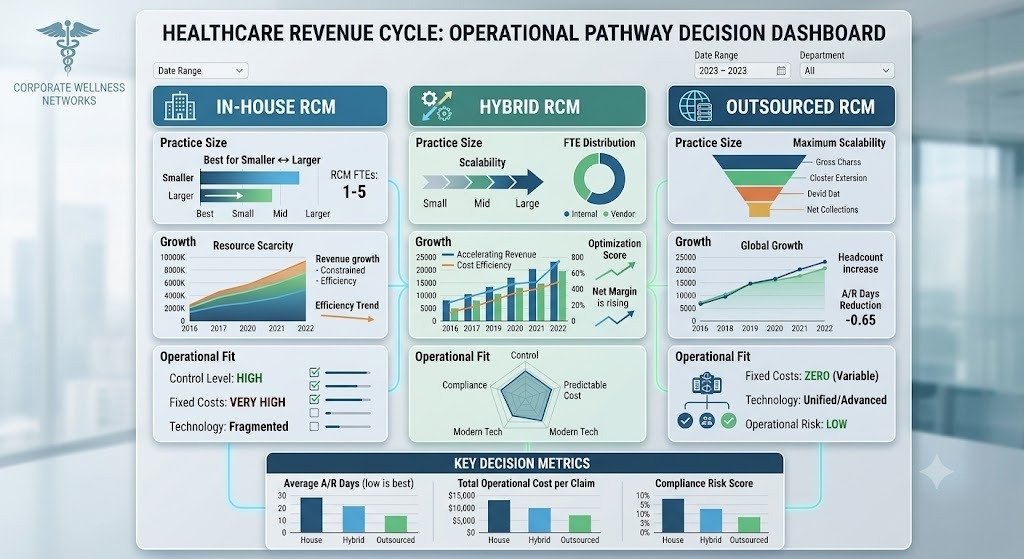
The Rise of Hybrid Revenue Cycle Management
Over the last several years, many successful practices have stopped viewing the decision as either “fully in-house” or “fully outsourced.”
Instead, they’ve adopted a hybrid model.
Hybrid Revenue Cycle Management combines the strengths of both approaches.
Your internal team continues managing patient-facing activities, while an experienced RCM partner handles specialized back-office functions.
Typical Hybrid Workflow
Your Practice Handles
• Patient scheduling
• Registration
• Insurance verification
• Front-desk collections
• Provider documentation
• Charge capture
Revenue Cycle Partner Handles
• Coding review
• Claim submission
• Clearinghouse management
• Payment posting
• Denial management
• Appeals
• Accounts receivable follow-up
• Revenue analytics
• Credentialing support
• Payer communications
This approach allows practices to maintain close patient relationships while leveraging specialized expertise where it has the greatest financial impact.
ClaimsMed Insight
The most successful practices don’t outsource because they’re struggling.
They outsource because they recognize that specialized expertise allows their internal teams to focus on higher-value work.
A Practical Plan to Outsource Medical Billing Seamlessly
Changing your billing model should never feel overwhelming.
Whether you’re outsourcing for the first time or restructuring an existing revenue cycle, following a phased implementation minimizes disruption.
Step 1: Measure Your Current Performance
Before changing anything, you must establish a baseline. For example, you should review the previous three to six months and carefully document:
• Clean Claim Rate
• Initial Denial Rate
• Net Collection Rate
• Days in Accounts Receivable
• Average Days to Payment
• Top Denial Categories
• Outstanding Aging Buckets
• Credentialing Timelines
Without baseline metrics, measuring improvement becomes impossible.
Step 2: Identify Where Revenue Is Escaping
While most practices immediately blame insurance companies, the problem often starts much earlier. Therefore, you should carefully review your workflows for:
• Registration accuracy
• Eligibility verification
• Prior authorization
• Coding quality
• Documentation
• Claim submission timing
• Denial follow-up
• Credentialing delays
Every revenue leak has a root cause.
Fixing that cause produces long-term improvement.
Step 3: Evaluate Technology
To gain clarity, ask yourself:
Does our software eliminate manual work?
Is your staff entering the same information twice?
Do you currently receive meaningful KPI reporting?
Can your team identify denial trends quickly?
Are your administrative systems communicating effectively?
Technology should simplify your revenue cycle—not complicate it.
Step 4: Choose the Right Partner
If outsourcing is the right decision, you must not choose a vendor solely based on price. Instead, remember to evaluate:
• Healthcare specialty experience
• Knowledge of your EHR
• Reporting capabilities
• Communication process
• Credentialing expertise
• Scalability
• Implementation plan
• Customer support
The right partner becomes part of your administrative team—not just another vendor.
Questions to Ask Before You Outsource Medical Billing
If you’ve decided to explore outsourcing, don’t choose a billing company based solely on price.
The lowest proposal isn’t always the most cost-effective, and the largest company isn’t automatically the best fit. The right partner should align with your specialty, technology, growth plans, and long-term business goals.
Use these questions during every conversation with a potential Revenue Cycle Management partner.
1. Do You Have Experience With My Specialty?
Billing requirements differ significantly between specialties.
Urgent care, primary care, behavioral health, cardiology, pain management, orthopedics, and surgery all have unique coding, documentation, payer, and reimbursement challenges.
Ask for examples of similar practices they currently support.
2. Which EHR and Practice Management Systems Do You Work With?
An outsourced medical billing company shouldn’t be learning your software after onboarding.
They should already understand how to work efficiently within your existing technology—or clearly explain how integration will be handled.
3. What KPIs Will You Report Every Month?
Every billing partner should provide meaningful reporting.
Ask whether they track:
• Clean Claim Rate
• Initial Denial Rate
• Days in Accounts Receivable
• Net Collection Rate
• Aging A/R
• Top Denial Reasons
• Payer Performance
• Collection Trends
If reporting is limited to “money collected,” you’re missing valuable operational insight.
Practice Owner Tip
If you can’t measure your revenue cycle, you can’t improve it.
Your billing partner should provide reports that support business decisions—not just accounting.
4. Who Will Be Managing My Account?
Know exactly who you’ll communicate with.
Ask:
• Will I have a dedicated account manager?
• Can you outline your typical turnaround for daily responses?
• How frequently will our teams review key performance metrics?
• Who explicitly handles our urgent account escalations?
Strong communication prevents small issues from becoming expensive problems.
5. How Do You Handle Claim Denials?
Every outsourced medical billing company says they reduce denials.
Ask how.
A quality partner should explain:
• Root cause analysis
• Appeal workflows
• Denial trending
• Preventive strategies
• Staff education
• Payer-specific processes
6. Do You Also Handle Credentialing?
Credentialing delays often create billing delays.
Working with one company that manages both billing and credentialing reduces administrative complexity and improves continuity.
7. How Do You Protect Patient Data?
Healthcare organizations remain responsible for HIPAA compliance even when outsourcing.
Verify:
• HIPAA compliance
• Business Associate Agreement (BAA)
• Encryption
• Access controls
• Cybersecurity policies
8. What Happens During Onboarding?
Implementation should be structured.
Ask about:
• Timeline
• Data migration
• Staff training
• Credentialing transition
• Historical A/R
• Go-live support
9. How Will Success Be Measured?
Before signing a contract, define success.
Examples include:
• Reduced denial rate
• Faster reimbursements
• Lower Days in A/R
• Improved clean claim rate
• Increased collections
• Better reporting
Clear expectations create better partnerships.
10. Can You Scale as My Practice Grows?
Your billing partner should support future growth—not limit it.
Whether you’re hiring providers, opening new locations, or expanding specialties, ask how they handle increasing claim volume.
ClaimsMed Insight
The best billing partner isn’t necessarily the least expensive.
It’s the one that consistently helps your practice collect more revenue while giving leadership better visibility into financial performance.
Bottom Line
Choosing an outsourced medical billing company is a strategic business decision—not simply an administrative purchase.
The right questions today can prevent years of operational frustration tomorrow.
Debunking 7 Myths When You Outsource Medical Billing
Many practices hesitate to outsource because of misconceptions they’ve heard from colleagues or previous experiences. Therefore, let’s separate fact from fiction.
Control and Practice Size Misconceptions
First Myth: “We’ll Lose Control of Our Billing.”
- The Reality: A professional Revenue Cycle Management partner should increase visibility rather than reducing it. For instance, modern billing companies provide dashboards, KPI reports, denial analytics, and dedicated account managers that often offer greater transparency than many internal departments. Consequently, you remain in control of strategic decisions while experienced specialists handle day-to-day billing operations.
Second Myth: “Outsourcing Is Only for Large Practices.”
- The Reality: Small and mid-sized practices frequently benefit the most from this setup. Specifically, outsourcing medical billing gives independent practices access to experienced billing professionals, advanced technology, and payer expertise without building an expensive internal department.
Third Myth: “Outsourcing Medical Billing Is Too Expensive.”
- The Reality: Comparing outsourcing fees only to employee salaries is highly misleading. On the contrary, the true comparison should include benefits, recruiting, staff turnover, software, compliance, training, management time, and revenue leakage. As a result, many practices discover outsourcing produces a stronger financial return despite paying a service fee.
Staffing and Implementation Misconceptions
Fourth Myth: “Our Current Staff Will Become Unnecessary.”
- The Reality: Many successful practices adopt a hybrid approach instead. Internal employees can continue focusing on patients, scheduling, eligibility verification, and front-office operations while specialized billing professionals manage complex revenue cycle functions. Ultimately, this structural change often improves staff satisfaction rather than replacing employees.
Fifth Myth: “Changing Billing Companies Will Disrupt Cash Flow.”
- The Reality: A structured implementation minimizes disruption entirely. Indeed, experienced Revenue Cycle Management companies transition practices gradually, establish parallel workflows when necessary, and provide implementation support to protect ongoing collections.
Sixth Myth: “Our Practice Is Too Small to Benefit.”
- The Reality: Every dollar matters much more in smaller operations. Therefore, reducing preventable denials, accelerating reimbursements, and improving operational efficiency often has an even greater financial impact for independent physicians than for large health systems.
Seventh Myth: “Technology Alone Can Solve Our Billing Problems.”
- The Reality: Technology is only one part of a successful revenue cycle. Even the most advanced software cannot replace experienced professionals who understand payer policies, coding requirements, denial management, and workflow optimization. In short, successful revenue cycles combine skilled people, efficient processes, reliable technology, and continuous improvement.
All four are essential.
ClaimsMed Insight
Software doesn’t improve collections by itself.
Well-designed workflows, experienced specialists, and consistent execution are what transform technology into measurable financial results.
Bottom Line
Outsourcing medical billing isn’t about giving up control.
It’s about giving your practice access to specialized expertise that strengthens financial performance while allowing your team to focus on patient care and strategic growth.
Free Revenue Cycle Scorecard
Is Your Revenue Cycle Healthy?
Answer these ten questions.
Give yourself:
Yes = 1 point
No = 0 points
1. Does your team maintain a Clean Claim Rate consistently above 95%?
2. Are your total Days in Accounts Receivable safely below 35 days?
3. Has your Initial Claim Denial Rate stayed under 5%?
4. Can leadership review accurate KPI reports every month?
5. Could your billing department continue operating smoothly if one employee resigned tomorrow?
6. Do you consistently follow up on denied claims within one week?
7. Are all providers currently credentialed and enrolled with contracted payers?
8. Do your billing workflows require minimal manual data entry?
9. Have you reviewed your revenue cycle within the last six months?
10. Do your physicians spend less than one hour each week dealing with billing issues?
Your Score
8–10
Excellent.
Your revenue cycle appears healthy.
Continue monitoring KPIs and optimizing performance.
5–7
Good, but opportunities exist.
A professional revenue cycle review may uncover hidden revenue leakage.
0–4
Your practice may be losing significant revenue through operational inefficiencies.
Now is an excellent time to perform a comprehensive revenue cycle assessment.
Discover How Healthy Your Revenue Cycle Really Is
A few “No” answers on this scorecard could represent thousands of dollars in delayed or lost revenue every year.
Claims Med offers a complimentary Revenue Cycle Assessment to help identify workflow bottlenecks, denial trends, credentialing gaps, and opportunities to improve collections.
It’s practical, data-driven, and tailored to your practice—without obligation.
Final Recommendations Before You Outsource Medical Billing
Choosing between outsourced medical billing and an in-house billing department isn’t about following industry trends.
It’s about selecting the model that best supports your practice’s financial health and long-term goals.
If your internal team consistently delivers excellent results, maintains low denial rates, and scales effectively with your growth, continuing in-house may be the right decision.
However, if you’re experiencing staffing challenges, increasing denials, aging accounts receivable, or leadership fatigue from managing billing operations, outsourcing medical billing or adopting a hybrid model may provide the expertise and scalability needed to move forward.
The goal isn’t simply processing claims.
The goal is building a revenue cycle that allows your providers to focus on patient care while ensuring your practice captures every dollar it earns.
Bottom Line
The best billing model is the one that consistently improves revenue, reduces administrative burden, and supports the future growth of your practice.
Frequently Asked Questions
Financial & Pricing Inquiries
Is outsourcing medical billing worth it for small practices?
Yes, because many small and mid-sized practices benefit from outsourcing to gain access to experienced billing professionals without the overhead of building a large internal department. Additionally, it significantly improves scalability as the practice grows.
How much do medical billing companies typically charge?
In general, most medical billing companies charge either a percentage of collections or a fixed monthly fee. Furthermore, exact pricing varies based on specialty, claim volume, and the scope of services provided.
Operations & Security Concerns
Can outsourcing medical billing improve cash flow?
Absolutely. Indeed, faster claim submission, stronger denial management, and proactive accounts receivable follow-up often reduce payment delays and dramatically improve overall cash flow.
Will I lose control of my billing process?
Not if you choose the right partner. On the contrary, modern Revenue Cycle Management companies provide transparent reporting, dedicated account managers, KPI dashboards, and regular performance reviews, allowing practice leadership to maintain visibility while reducing administrative workload.
Is outsourcing medical billing HIPAA compliant?
Yes, professional medical billing companies strictly maintain HIPAA-compliant workflows, secure data handling procedures, and Business Associate Agreements (BAAs). However, you should always verify compliance before selecting a partner.
What is the biggest mistake practices make when comparing billing options?
Focusing only on up-front costs. Instead, practices should compare total operational performance—including collections, denial rates, staffing stability, technology, leadership time, and long-term scalability—rather than just monthly expenses.
If You Only Remember Five Things…
✅ Medical billing is a revenue strategy—not just an administrative task.
✅ Compare total operational costs, not just salaries.
✅ Monitor KPIs before making major billing decisions.
✅ Growth requires scalable billing infrastructure.
✅ The right billing partner should increase transparency, improve collections, and allow your team to focus on delivering exceptional patient care.
Ready to Find Out If Your Billing Process Is Costing You Money?
Every healthcare practice has opportunities to strengthen its revenue cycle.
The challenge is identifying those opportunities before they affect cash flow, provider satisfaction, and long-term growth.
At Claims Med, we partner with healthcare organizations across multiple specialties to improve medical billing, provider credentialing, denial management, and revenue cycle performance through experienced professionals, technology-driven workflows, and data-backed decision-making.
Whether you currently manage billing internally or work with another billing company, an independent review can reveal opportunities to increase collections and streamline operations.
Request Your Complimentary Revenue Cycle Assessment
Ready to outsource medical billing? Contact Claims Med today to learn how our Revenue Cycle Management team can improve your practice’s financial performance.
We’ll help you identify:
✓ Revenue leakage opportunities
✓ High-impact denial trends
✓ Credentialing bottlenecks
✓ Aging Accounts Receivable concerns
✓ Workflow inefficiencies
✓ KPI improvement opportunities
📞 Call: (713) 893-4773
📧 Email: info@claimsmed.com
🌐 Visit: https://claimsmed.com
Final Takeaway
Medical billing isn’t simply about getting insurance claims paid. On the contrary, it is about building a structurally healthier, more profitable medical practice.
Therefore, whether you ultimately choose an in-house team, an outsourced billing partner, or a hybrid revenue cycle model, your final choice must be based entirely on measurable performance rather than unbacked assumptions. In fact, the medical practices that thrive over the next decade will not necessarily be the ones with the largest administrative departments. Instead, they will be the organizations operating with the smartest revenue cycle management strategies.
CEO’s 60-Second Summary
To conclude, if you’re still deciding whether to outsource your medical billing, keep these five essential points in mind:
- First, don’t compare outsourcing fees to basic employee salaries alone—compare your total loaded operational costs.
- Next, accurately measure your current performance metrics before making any major structural changes.
- Third, remember that high denial rates, staffing turnover, and growing A/R are clear warning signs your revenue cycle needs urgent attention.
- Furthermore, the best billing model is always the one that successfully improves your net collections, not simply the one that looks cheaper on paper.
- Finally, whether you choose an in-house, outsourced, or hybrid approach, your revenue cycle infrastructure must actively support your practice’s long-term growth rather than holding it back.
One final question to ask yourself:
“If my lead biller resigned tomorrow morning, would my revenue cycle continue operating without interruption?”
If the answer is no, it’s time to evaluate whether your current billing model is truly supporting your practice’s future.