
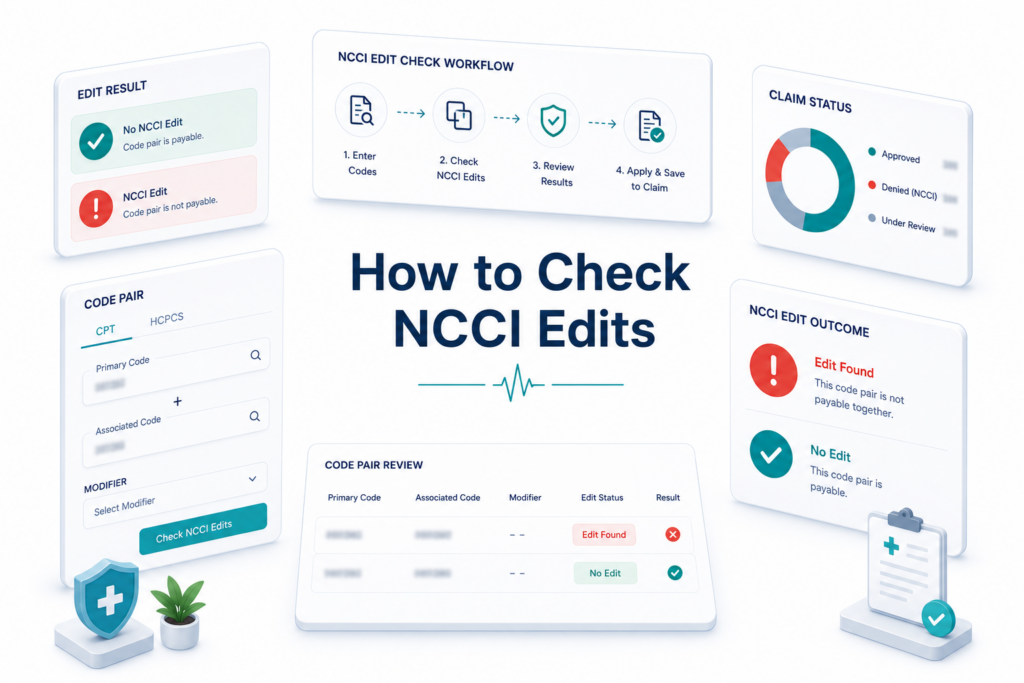
Medical billing accuracy is critical for maintaining a healthy revenue cycle. One of the most overlooked causes of claim denials and reimbursement delays is failing to review National Correct Coding Initiative (NCCI) edits before claim submission. Understanding how to check NCCI edits can help healthcare providers, practice managers, and medical billing teams prevent avoidable denials, reduce compliance risks, and improve reimbursement outcomes.
Developed by the Centers for Medicare & Medicaid Services (CMS), NCCI edits are automated coding rules that identify CPT and HCPCS code combinations that should not normally be billed together. These edits help prevent improper payments and ensure coding accuracy across healthcare claims processing.
When practices ignore NCCI edits, the consequences often include claim denials, payer rejections, increased accounts receivable, audit exposure, and lost revenue. Therefore, implementing a consistent NCCI review process is essential for protecting both compliance and cash flow.
Why NCCI Edits Matter in Medical Billing
NCCI edits are designed to prevent unbundling and duplicate billing. They evaluate code pairs billed by the same provider for the same patient on the same date of service.
For example, a surgical procedure may already include services that cannot be billed separately. If a billing team submits both codes without verifying the edit, the payer may automatically deny the secondary service.
As a result, healthcare organizations often face:
- Increased claim denials
- Delayed reimbursements
- Higher denial management costs
- Increased payer scrutiny
- Compliance and audit risks
- Lost revenue opportunities
Even a small number of recurring coding errors can create significant financial challenges over time.
The Real-World Impact of NCCI Bundling Errors
Consider an orthopedic practice performing an arthroscopic shoulder decompression and an arthroscopic distal clavicle excision during the same operative session.
The billing team submits both CPT codes without checking current NCCI guidance. Two weeks later, the payer reimburses the primary procedure but denies the secondary code as bundled.
Consequently, staff must investigate the denial, review documentation, submit corrections, and potentially file an appeal. What could have been a clean claim now creates unnecessary administrative work and reimbursement delays.
Had the team reviewed the NCCI edit beforehand, they would have understood whether a modifier was appropriate and how the payer would process the claim.
How to Check NCCI Edits: A 6-Step Process
Learning how to check NCCI edits does not require advanced coding expertise. However, it does require a structured workflow that can be applied consistently before claims are submitted.
Step 1: Identify the CPT or HCPCS Code Pair
NCCI edits always evaluate relationships between two procedure codes. Therefore, begin by identifying the exact code pair you plan to bill together.
For example:
- CPT 29826 – Arthroscopic shoulder decompression
- CPT 29824 – Arthroscopic distal clavicle excision
Without identifying both codes, it is impossible to evaluate the edit correctly.
Step 2: Access the CMS NCCI PTP Tables
Next, review the official Procedure-to-Procedure (PTP) edit tables published by CMS.
You can access NCCI data through:
- CMS quarterly NCCI edit files
- Codify
- Find-A-Code
- Integrated coding software
- EHR coding tools
Each table includes:
| Column | Description |
|---|---|
| Column 1 | Comprehensive procedure |
| Column 2 | Component procedure |
| Modifier Indicator | Billing flexibility |
| Effective Date | Edit start date |
| Termination Date | Edit expiration date |
These fields determine whether the code combination can be billed together.
Step 3: Perform a Directional Search
NCCI edits are directional, meaning the same code pair may trigger an edit in one sequence but not in the reverse order.
Therefore:
- Search the primary procedure in Column 1.
- Look for the secondary procedure in Column 2.
- If not found, reverse the search.
Only the exact CMS sequence determines whether an edit applies.
Step 4: Review the Modifier Indicator
Once you locate the code pair, review the Modifier Indicator carefully.
- Indicator 0: These codes are permanently bundled and the secondary code will be denied if billed separately.
- Indicator 1: These codes may be billed together when documentation supports distinct services and the appropriate modifier is used.
- Indicator 9: CMS has removed the edit, so the code pair can generally be billed together without modifier restrictions.
Related reading: Denial Code 129: Prior Processing Error Fix
Step 5: Verify Clinical Documentation
A Modifier Indicator of 1 allows separate billing only when the medical documentation supports distinct services.
Review the operative note, procedure report, or progress documentation and determine:
- Were services performed at separate anatomical sites?
- Did separate encounters occur?
- Were procedures truly distinct and non-overlapping?
- Does documentation clearly support separate reimbursement?
Without adequate documentation, modifier use may create compliance concerns and increase audit exposure.
Step 6: Apply the Appropriate Modifier
If documentation supports separate billing and the Modifier Indicator equals 1, the next step is applying the correct modifier.
Common modifier options include:
- Modifier 59 – Distinct procedural service
- Modifier XE – Separate encounter
- Modifier XS – Separate structure
- Modifier XP – Separate practitioner
- Modifier XU – Unusual non-overlapping service
Selecting the correct modifier is critical because incorrect modifier use can lead to claim denials, payer reviews, and reimbursement recoupments.
Related reading: Medical Billing Denial Codes
Best Practices for Managing NCCI Edits
Healthcare organizations can reduce denials and improve coding accuracy by implementing the following strategies:
- Review NCCI edits before claim submission.
- Update coding software regularly.
- Train coding and billing staff on modifier usage.
- Conduct routine coding audits.
- Monitor payer-specific bundling policies.
- Maintain detailed clinical documentation.
These proactive steps help strengthen reimbursement workflows and reduce preventable revenue leakage.
Improve Revenue Cycle Performance With Better NCCI Management
Understanding how to check NCCI edits is no longer optional for modern healthcare organizations. Accurate NCCI review protects practices from claim denials, coding errors, compliance risks, and reimbursement delays.
By implementing a structured six-step review process, healthcare providers can improve coding accuracy, submit cleaner claims, and strengthen overall revenue cycle performance.
If your organization is struggling with coding denials, modifier errors, payer rejections, or reimbursement delays, Claims Med can help. Our team provides expert medical billing, coding audits, denial management, and healthcare revenue cycle management services designed to maximize collections and reduce preventable claim issues.
Get in Touch: (713) 893-4773 | Email: info@claimsmed.com