
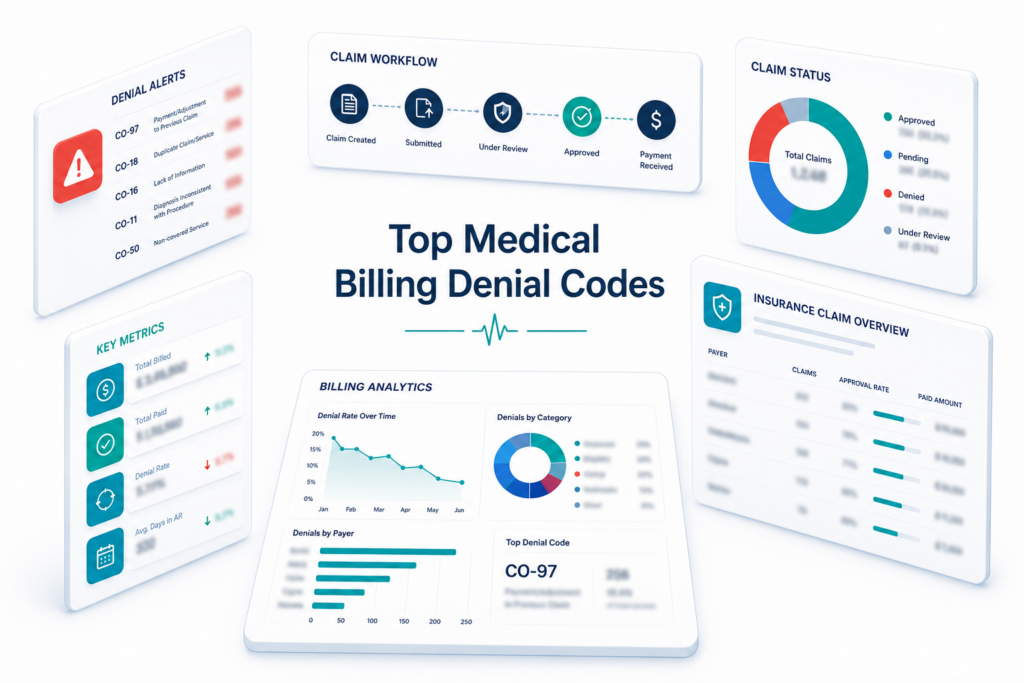
For healthcare providers and practice managers, understanding the Top Medical Billing Denial Codes is no longer optional. In 2026, claim denials directly impact reimbursement timelines, staffing costs, and overall financial performance. Even high-performing practices lose substantial revenue because of preventable billing mistakes hidden inside everyday workflows.
Today’s payer systems use automated claim edits, AI-driven audits, and stricter reimbursement rules. As a result, billing teams must identify denial patterns early and resolve operational gaps before claims reach the payer.
Practices that strengthen front-end verification, coding accuracy, and authorization workflows consistently recover more revenue and reduce administrative burden.
Why Medical Billing Denials Continue to Increase
Modern healthcare revenue cycle management depends on clean claims. However, many practices still rely on outdated manual processes that increase billing risk.
Most denials occur because of:
- Missing claim information
- Eligibility verification failures
- Authorization errors
- Incorrect coding
- Coordination of Benefits issues
- Timely filing delays
These problems create serious operational consequences:
- Delayed reimbursements
- Increased accounts receivable days
- Higher appeal workloads
- Lost revenue opportunities
- Reduced cash flow predictability
More importantly, repeated denials force billing teams into reactive workflows instead of proactive revenue optimization.
The Top Medical Billing Denial Codes in 2026
1. CO-16 — Missing Information or Claim Errors
CO-16 remains one of the most common denial codes in healthcare billing. This denial occurs when claims contain incomplete or invalid data such as:
- Missing modifiers
- Incorrect patient demographics
- Invalid NPI information
- Missing diagnosis details
For example, missing modifier -25 or incomplete Social Determinants of Health (SDOH) documentation now triggers frequent denials in 2026.
Prevention Strategy:
Implement automated claim scrubbing tools with hard-stop edits before submission.
(Related reading: Denial Code CO-16 Fix Guide)
2. CO-18 — Duplicate Claim or Service
CO-18 appears when payers believe the practice submitted the same claim twice.
This usually happens when billing teams resubmit claims before checking payer status updates.
Prevention Strategy:
Always verify payer portal activity before resubmitting claims and use proper corrected claim frequency codes.
3. CO-22 — Coordination of Benefits (COB) Issues
CO-22 occurs when the wrong payer receives the claim first.
Patients with dual coverage often create payer sequencing issues if staff fail to update insurance information regularly.
Prevention Strategy:
Use Real-Time Eligibility (RTE) verification at every visit, not just annually.
(Related reading: CO-22 Denial Code Prevention)
4. CO-29 — Timely Filing Limit Exceeded
CO-29 represents one of the most damaging denials because recovery opportunities become extremely limited after filing deadlines expire.
Delayed submissions often result from:
- Backlogged billing departments
- Credentialing delays
- Missing documentation
Prevention Strategy:
Set automated aging alerts for claims older than 30 days.
5. CO-45 — Charges Exceed Fee Schedule
CO-45 means the billed amount exceeds the payer’s contracted allowable rate.
Although many adjustments are legitimate, underpayments frequently occur because practices fail to monitor payer contracts carefully.
Prevention Strategy:
Use contract management tools to compare expected reimbursement against actual payer payments.
6. CO-50 — Non-Covered Services
CO-50 appears when payers determine the service is not covered under the patient’s plan.
This denial commonly affects:
- Preventive services
- Experimental treatments
- Specialty procedures
Prevention Strategy:
Obtain signed financial waivers or Advanced Beneficiary Notices (ABNs) before treatment.
(Related reading: Denial Code 50 Medical Necessity Guide)
7. CO-96 — Non-Covered Charges
CO-96 often involves services considered experimental or medically unnecessary.
Telehealth expansions and genetic testing services now trigger increased scrutiny from payers.
Prevention Strategy:
Link procedure codes to strong ICD-10 documentation supporting medical necessity.
8. CO-97 — Service Included in Another Procedure
CO-97 indicates the payer considers the service bundled into another reimbursable procedure.
Improper modifier usage frequently causes this denial.
Prevention Strategy:
Review National Correct Coding Initiative (NCCI) edits carefully and only append modifiers when documentation supports separate services.
9. PR-1 — Deductible Amount
PR-1 is not technically a billing error. Instead, it shifts payment responsibility to the patient because the deductible remains unmet.
However, poor patient collection workflows often turn these balances into bad debt.
Prevention Strategy:
Use point-of-service collections and credit-card-on-file systems to improve patient payment capture.
10. CO-197 — Prior Authorization Missing
CO-197 remains one of the most preventable—and expensive—denials in healthcare billing.
This denial occurs when services require authorization but the practice fails to obtain approval before treatment.
Prevention Strategy:
Centralize authorization workflows and assign dedicated authorization specialists.
(Related reading: Prior Authorization Denials Guide)
Real-World Revenue Impact
Consider an orthopedic clinic performing 20 injections weekly. If the staff misses several insurance updates and fails to secure prior authorizations consistently, multiple claims deny every week.
At only a few hundred dollars per denied claim, annual revenue loss can easily exceed six figures.
This demonstrates why denial prevention directly impacts clinic profitability.
How Practices Reduce Denials Successfully
High-performing organizations now focus heavily on:
- Automated claim scrubbing
- Real-time eligibility verification
- Monthly credentialing audits
- Denial trend analysis
- Front-end staff training
These strategies improve insurance claims processing, reduce rework, and strengthen reimbursement workflows significantly.
Fix Top Medical Billing Denial Codes Before They Damage Revenue
The Top Medical Billing Denial Codes continue to create major financial pressure for healthcare practices in 2026. However, most denials remain preventable with stronger workflows, better coding accuracy, and proactive revenue cycle management.
Practices that prioritize clean claims, eligibility verification, and authorization management consistently improve cash flow and reduce administrative burden.
At Claims Med, we help healthcare organizations reduce denials, optimize medical billing performance, and maximize reimbursements through expert revenue cycle management solutions.
Contact Claims Med today. Let our billing experts help your practice stop revenue leakage and improve financial stability.