
Eligibility & COB Billing

Dual-Eligible Patient Responsibility Script

Dual-Eligible Patient Responsibility Script Guide

For healthcare practices, the Dual-Eligible Patient Responsibility Script is no longer optional—it is a frontline revenue protection tool. In today’s complex billing environment, where patients qualify for both Medicare and Medicaid, front-desk communication directly impacts claim outcomes, reimbursement timelines, and denial rates. Without a structured approach, practices risk billing confusion, patient dissatisfaction, and significant revenue […]

Dual-Eligible Patient Responsibility Script Guide Read More »

Dual-Eligible Eligibility Verification

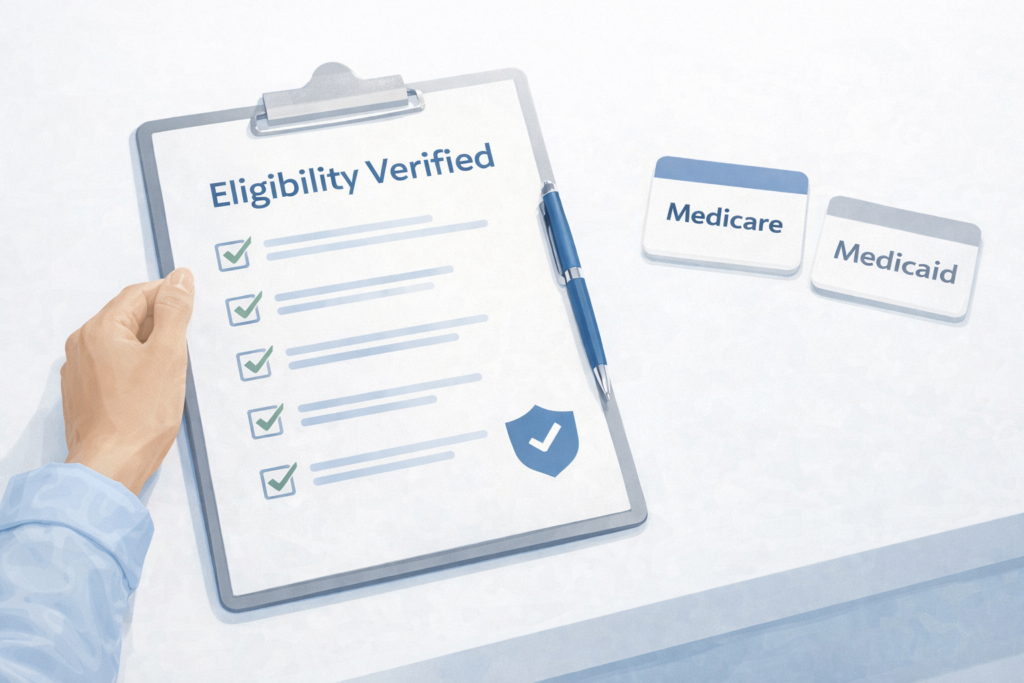
Dual-Eligible Eligibility Verification Checklist 2026

For healthcare practice managers and front-desk teams, Dual-Eligible Eligibility Verification is one of the most critical safeguards against claim denials and A/R delays. In 2026, with continued expansion of D-SNP plans and evolving Medicaid redeterminations, verifying dual coverage accurately at check-in is no longer optional—it is essential for clean claim submission. Below is a practical,

Dual-Eligible Eligibility Verification Checklist 2026 Read More »

Dual-Eligible Billing

Dual-Eligible Billing in 2026: Prevent Revenue Loss

For healthcare practice managers and owners, Dual-Eligible Billing has become a critical financial priority. With more than 12 million Americans qualifying for both Medicare and Medicaid, this population represents both opportunity and risk. In 2026, mastering Dual-Eligible Billing is not only about coordinating care — it is about preventing claims from falling into costly A/R

Dual-Eligible Billing in 2026: Prevent Revenue Loss Read More »

CO-22 denials

CO-22 Denials: COB Mistakes Fix Guide 2026

For healthcare administrators and practice managers, the CO-22 denials represents one of the most frustrating forms of revenue leakage. These denials, which signal a failure in Coordination of Benefits (COB), are entirely preventable. They waste countless hours of staff time, delay payment, and severely disrupt cash flow. However, by implementing a rigorous, multi-step COB management

CO-22 Denials: COB Mistakes Fix Guide 2026 Read More »

N30 Denial Code

N30 Denial: Stop Eligibility Rejections

For healthcare practices, N30 denials create unnecessary revenue loss. Insurers reject claims because of patient eligibility issues. These frustrating denials often stem from coverage gaps, authorization problems, or verification errors. Fortunately, most are preventable with proper protocols. Therefore, understanding the root causes and implementing targeted solutions can help you establish systematic N30 denial code prevention.

N30 Denial: Stop Eligibility Rejections Read More »

N219 Denial Code

N219 Denial: COB Fix Steps to Prevent Denials

Does your practice consistently lose money to N219 denials? If so, you are not alone. This frustrating adjustment occurs when secondary payers unilaterally reduce payments. They base the reduction on the primary payer’s allowed amounts. For practice managers and billing teams, this creates lost reimbursements, wasted appeal time, and unnecessary cash flow gaps. The good

N219 Denial: COB Fix Steps to Prevent Denials Read More »

Denial Code 31

Denial Code 31: Fix Patient ID Verification

Healthcare practices lose significant revenue to Denial Code 31. This occurs when insurers cannot match patient information to their records. For practice managers and providers, these preventable denials create unnecessary administrative burdens and cash flow disruptions. Therefore, establishing a clear strategy for Denial Code 31 prevention is essential. You must achieve perfect patient identity and

Denial Code 31: Fix Patient ID Verification Read More »

MA04 denial code

MA04 Denial: Fix Medicare Secondary Claims

MA04 denials stop Medicare secondary claims dead in their tracks. This occurs when primary payer information is missing or incomplete. For practice managers and billing teams, these preventable denials mean delayed payments, frustrating rework, and unnecessary cash flow gaps. The good news is that 90% of MA04 denials can be eliminated with proper Coordination of

MA04 Denial: Fix Medicare Secondary Claims Read More »

Denial Code 23

Denial Code 23: Prior Payer Fix Steps

For practice managers, healthcare providers, and practice owners, Denial Code 23 Prior Payer is a persistent and complex challenge. This denial code typically arises when the subsequent payer rejects a claim due to issues related to the primary payer’s adjudication. These issues include incorrect payments, miscalculations, or misinterpretations of the original claim details. Consequently, this

Denial Code 23: Prior Payer Fix Steps Read More »