

Knowing how to choose a medical billing company can help your practice avoid weak denial follow-up, aging A/R, unclear fees, poor reporting, and difficult contract terms. In 2026, practices should compare the entire revenue cycle operation before selecting a billing partner.
The best medical billing company is not necessarily the one offering the lowest percentage. It is the partner that can clearly explain how it will manage claims, denials, aging A/R, payer communication, reporting, compliance, implementation, and accountability, and prove that its processes fit your practice.
A low fee attached to poor follow-up can be expensive. A higher fee attached to stronger workflows may produce a much better financial outcome.
That is why practice owners, physicians, administrators, and billing managers should evaluate the entire revenue cycle before signing a contract.
This guide gives you 12 questions to ask every medical billing company you are considering in 2026, and explains what a strong answer should sound like.
Table of Contents

How to Choose a Medical Billing Company That Fits Your Practice
Your medical billing partner touches nearly every part of the revenue cycle.
A claim can fail long before a biller actually submits it. Incorrect demographics, inactive insurance, missing authorization, incomplete documentation, credentialing problems, coding errors, payer configuration issues, or delayed follow-up can all interfere with reimbursement.
That means the company you hire must understand more than claim submission.
It should understand the connection between front-office accuracy, coding, payer enrollment, claims processing, denial management, payment posting, accounts receivable, and reporting.
A vendor that focuses only on transmitting claims may leave significant gaps elsewhere.
A strong RCM partner should be able to tell you not only what happened to a claim, but also why it happened, what is being done about it, and how the same problem will be prevented in the future.
That distinction matters.
The 12 Questions

1. How to Compare Medical Billing Companies Beyond Price
Start here.
“Full-service medical billing” can mean very different things depending on the company.
One proposal may include claim submission, payment posting, denial management, appeals, A/R follow-up, patient statements, coding review, and reporting.
Another may include only claim transmission and basic posting while charging separately for other functions.
Before comparing prices, make each vendor define its scope.
Ask specifically whether the quoted fee includes:
- Claim creation and submission
- Claim scrubbing
- Coding review or coding services
- Rejection correction
- Denial management
- Appeals
- Payment posting
- ERA reconciliation
- Insurance A/R follow-up
- Patient billing
- Clearinghouse services
- Eligibility verification
- Prior authorization support
- Credentialing assistance
- Monthly reporting
- Payer communication
Two vendors charging the same percentage may provide completely different levels of service.
Understanding how to choose a medical billing company requires looking beyond the quoted percentage and evaluating the complete revenue cycle operation.
Do not compare percentages until you have compared scope.
2. How Is Pricing Structured and What Could Cost Extra?
Medical billing companies typically structure pricing around a percentage of collections, a fixed fee, a per-claim charge, or a customized model.
None is automatically superior.
The right structure depends on claim volume, specialty, payer mix, service scope, staffing needs, and complexity.
The more important question is:
What will the practice actually pay after every additional charge is included?
Ask whether the contract includes separate fees for onboarding, clearinghouse transactions, eligibility checks, coding, patient statements, old A/R, credentialing, data migration, reporting, interfaces, or early termination.
Then request examples.
For instance:
If our collections increase substantially, how will our fee change?
If claim volume decreases, is there a minimum monthly fee?
Does the percentage apply to insurance collections only, or to patient payments as well?
Are payments collected before the vendor begins services included?
These details prevent surprises later.
A transparent billing partner should be comfortable explaining exactly how invoices are calculated.
3. Who Handles Denials, and What Happens After a Claim Is Denied?
Almost every vendor will say, “We handle denials.”
That answer is not enough.
Ask what happens operationally.
A mature denial management process should distinguish between isolated claim problems and recurring revenue-cycle defects.
For example, repeated denials involving eligibility may indicate a registration issue. Authorization denials may point to front-office workflow gaps. Provider-related denials may originate from enrollment or credentialing. Coding denials may require documentation or coding review.
The goal should not simply be:
deny → correct → resubmit
It should become:
deny → identify root cause → correct → recover → prevent recurrence
Claims Med’s denial management services, for example, emphasize root-cause review, correction, resubmission, payer communication, and prevention rather than treating every denial as an isolated transaction.
Ask every prospective vendor:
How are denials categorized?
Who owns appeals?
How are recurring patterns reported?
How quickly are denials worked?
How are unresolved claims escalated?
Will our practice see denial trends?
If they cannot clearly describe the workflow, keep evaluating.

4. How Will You Manage Our Aging Accounts Receivable?
A/R deserves its own conversation.
New claims tend to receive the most attention because they are easier to submit and track. Older balances require persistent follow-up, payer calls, corrected claims, documentation, appeals, or deeper investigation.
Ask the vendor how it divides A/R by aging bucket and how work is prioritized.
You should understand what happens to balances in:
0–30 days, 31–60 days, 61–90 days, 91–120 days, and beyond 120 days.
Then ask an even more important question:
What happens to our existing A/R when you take over?
Some vendors include legacy A/R.
Others charge separately.
Some may exclude balances older than a certain date.
The contract should make this unmistakably clear.
Also determine what happens to outstanding A/R if you eventually terminate the relationship. Your practice should know who will continue working the claims, for how long, and how records will be transferred.
5. How Quickly Are Claims Submitted and Followed Up?
Cash flow is influenced by what happens between the patient encounter and claim submission.
Ask the company to explain its normal workflow from charge receipt to submission.
That conversation should include:
- Documentation dependencies
- Coding review
- Claim scrubbing
- Clearinghouse rejection handling
- Payer acceptance
- Follow-up timing
- Unpaid-claim escalation
Be cautious of vendors that promise unrealistic universal turnaround times.
Different claims require different information, and incomplete documentation can delay billing regardless of who manages the revenue cycle.
A stronger answer explains both the expected workflow and the exceptions.
Also ask who alerts the practice when documentation, provider information, authorization details, or other missing items are preventing submission.
A good RCM company should surface problems quickly rather than allowing charges to quietly accumulate.

6. What Reporting Will We Receive and Can We Actually Use It?
A monthly collections total is not an RCM report.
Practice leadership needs enough visibility to understand whether revenue-cycle performance is improving or deteriorating.
Ask whether reporting includes areas such as:
- Charges
- Payments
- Adjustments
- Denial trends
- A/R aging
- Payer performance
- Claim status
- Outstanding balances
- Collection trends
- Unresolved issues
More importantly, ask who will explain the report.
Data without interpretation often creates more questions than answers.
A useful review should connect performance to action.
Instead of:
“Your denials increased.”
Leadership needs:
“Authorization denials increased in this payer segment. These three workflow changes are being implemented to address the issue.”
That is the difference between reporting activity and managing a revenue cycle.
Claims Med currently positions real-time reporting, analytics, and structured RCM oversight as part of its outsourced billing model.
7. How Does the Company Handle Payer Problems?
Medical billing involves frequent payer interaction.
Claims get stuck.
Enrollment records become inconsistent.
Requests for documentation appear.
Payers change processing rules.
Claims are underpaid, rejected, or processed differently than expected.
Ask who handles those situations.
Does the vendor have a dedicated payer-support process?
Will your staff need to make most payer calls?
How are payer reference numbers documented?
Who follows unresolved cases?
How are payer-specific trends communicated?
A medical billing partner should reduce the amount of payer chasing your internal team performs, not simply tell your staff what number to call.
For practices dealing with high claim volume or multiple insurers, responsive payer communication can be just as important as claim submission itself.
8. Does the Billing Team Understand Your Specialty?
An urgent care center does not operate like a behavioral health practice.
A multi-location primary care group does not have the same billing workflow as a specialist office.
Specialty affects documentation, coding patterns, payer policies, authorizations, claim frequency, place of service, patient responsibility, and revenue-cycle workflow.
Ask prospective vendors which specialties they support and how their processes change by specialty.
Avoid accepting:
“We bill every specialty.”
Follow with:
How would you manage ours differently?
The answer should demonstrate operational understanding rather than simply repeat a sales statement.
For multi-provider or multi-location organizations, also ask how responsibilities are separated by provider, facility, payer, location, or service line.
Scalability matters if you plan to add clinicians or locations.
9. Who Handles Credentialing and Enrollment Problems?
A perfectly coded claim still cannot solve an enrollment problem.
Provider credentialing, payer enrollment, demographic changes, location additions, reassignment issues, and effective-date discrepancies can create reimbursement problems that look like billing issues.
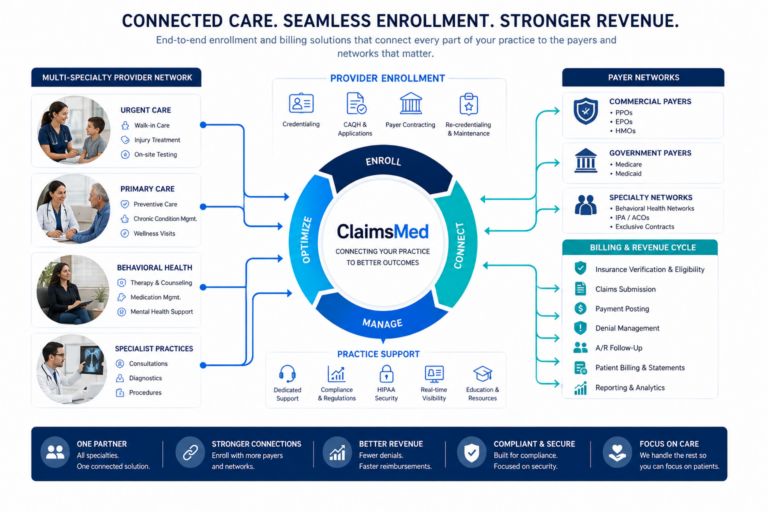
This is one reason practices should evaluate billing and credentialing as connected workflows.
Ask:
Does the billing company monitor provider enrollment issues?
Will it identify credentialing-related denials?
Can the team coordinate enrollment follow-up?
Who communicates with the payer?
How are expiring or changing provider records tracked?
If credentialing is handled by another department or company, determine how information moves between the teams.
Claims Med’s broader healthcare revenue-cycle model connects provider enrollment and credentialing with billing, denial management, practice support, and payer follow-up rather than treating each function as completely isolated.

10. How Is Patient and Practice Data Protected?
Any vendor handling protected health information deserves serious due diligence.
If a medical billing company creates, receives, maintains, or transmits PHI on behalf of a HIPAA-covered practice, it generally functions as a business associate, and the relationship requires an appropriate written business associate agreement.
HHS states that business associate contracts must address permitted uses and disclosures of PHI, safeguards, incident reporting, subcontractor obligations, and other required protections.
Ask the vendor:
Will you execute a Business Associate Agreement?
How is access to PHI controlled?
How are workforce permissions managed?
How are security incidents reported?
Do subcontractors access PHI?
What happens to PHI when the relationship ends?
HHS guidance also addresses the return or destruction of PHI at termination where feasible and requires appropriate protections when information must continue to be retained.
Your service agreement and BAA should be reviewed carefully and, where appropriate, with qualified legal or compliance counsel.
11. What Will Implementation Actually Look Like?
A great proposal can still become a poor implementation.
Before signing, ask for an onboarding plan.
You should understand:
Who does what, by when, and what information is required from your practice.
Implementation may involve access to the EHR or practice-management system, clearinghouse configuration, payer information, provider rosters, fee schedules, bank or ERA setup, A/R reports, workflow mapping, patient statement processes, and existing billing data.
Ask whether the vendor will run old and new workflows in parallel during transition.
Determine how unsubmitted encounters, unresolved denials, open claims, credits, patient balances, and existing A/R will be handled.
Also identify one accountable person on each side.
Implementation problems frequently occur when everyone is involved but nobody owns the transition.

12. What Are the Contract, Renewal, Data-Access, and Termination Terms?
Do not leave the legal section until the final five minutes of the sales call.
Read it early.
Your team should understand:
- Initial contract term
- Automatic renewal language
- Notice period
- Termination rights
- Early termination fees
- Data-access rights
- Post-termination A/R responsibilities
- Ownership of reports and billing data
- Transition assistance
- PHI handling after termination
- Payment obligations after termination
Pay particular attention to access.
A practice should not discover after termination that retrieving its own billing information is difficult.
HHS has specifically addressed access to ePHI maintained by business associates and notes that availability means the information must remain accessible and usable by the covered entity.
Commercial terms can vary significantly, so have the agreement reviewed appropriately before execution.
Red Flags That Should Make You Reconsider a Medical Billing Company
Some warning signs deserve more weight than a polished sales presentation.
Be cautious when a vendor cannot explain its fee calculation clearly, provides no meaningful reporting process, has vague A/R responsibilities, does not define denial ownership, cannot explain implementation, avoids discussing data access, or pressures you to sign before you fully understand the agreement.
Another warning sign is excessive emphasis on a single headline metric.
Revenue cycle performance cannot be judged by one number.
A vendor promising a spectacular clean-claim rate means little if it does not explain what the metric includes, how it is calculated, what happens after a denial, or whether older A/R is being recovered.
Ask for definitions.
Ask for workflows.
Ask for accountability.
How to Choose a Medical Billing Company Based on Performance
Create a scorecard before attending vendor demonstrations.
Do not allow the sales presentation to define your evaluation criteria.
Score each company across the same categories:
| Evaluation Area | What You Should Determine |
| Service Scope | What is included and excluded? |
| Pricing | What will you actually pay? |
| Denials | Who owns prevention, correction, and appeals? |
| A/R | How aggressively is aging revenue worked? |
| Reporting | Can leadership see and understand performance? |
| Specialty Fit | Does the team understand your workflow? |
| Credentialing | Can enrollment problems be identified and coordinated? |
| Payer Support | Who follows unresolved payer issues? |
| Technology | How will systems and data integrate? |
| Compliance | Are PHI safeguards and BAA terms appropriate? |
| Implementation | Is there a defined transition plan? |
| Contract | Can you exit cleanly and retain access to your data? |
A vendor does not need to be perfect in every category.
But weaknesses should be visible before the agreement is signed, not discovered six months later.

How to Choose a Medical Billing Company Based on ROI
Imagine Company A charges less but provides limited denial follow-up, weak reporting, and minimal A/R recovery.
Company B costs more but identifies recurring denials, follows unpaid claims aggressively, supports payer communication, improves visibility, and reduces administrative burden on your team.
The cheaper company may ultimately cost the practice more.
That is why vendor evaluation should focus on revenue retained and operational performance, not simply the vendor’s percentage.
Ask:
What work will our staff no longer need to perform?
What revenue problems will this company actively manage?
What visibility will leadership gain?
What happens when something goes wrong?
How will we know whether the relationship is working?
A strong partner should welcome those questions.
When deciding how to choose a medical billing company, compare revenue retained, denial follow-up, A/R performance, reporting, and support alongside pricing.
How Claims Med Approaches Revenue Cycle Partnership
Claims Med’s approach extends beyond basic claim submission.
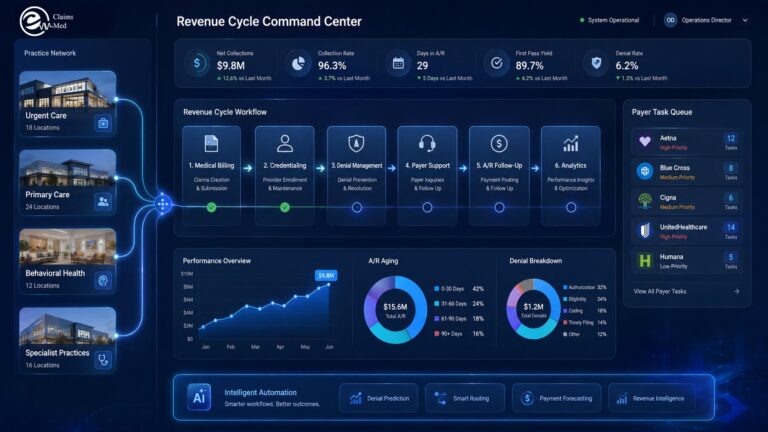
Its broader RCM model connects medical billing, denial management, provider credentialing, payer support, A/R follow-up, analytics, and practice workflows so that problems can be addressed across the revenue cycle rather than in isolation.
The team supports multi-specialty workflows and uses internal workflow technology to organize revenue-cycle activity and communication. Same-day payer support is designed to help escalate payer issues without leaving practices to coordinate every follow-up independently.
That integrated approach matters because many reimbursement problems cross departmental lines.
A denial may actually be a credentialing problem.
A slow payment may originate with missing documentation.
An A/R issue may trace back to payer configuration.
The goal should be to understand the entire revenue path, not simply move claims from one status to another.
Before You Sign: Your Final 12-Question Checklist
Before selecting a medical billing company, make sure you can confidently answer these questions:
- What services are included in the quoted fee?
- How is pricing calculated, and what costs extra?
- Who manages denials and appeals?
- How will new and legacy A/R be handled?
- What is the claim-submission and follow-up workflow?
- What reports and dashboards will leadership receive?
- Who handles payer communication and escalations?
- Does the team understand our specialty and practice model?
- How are credentialing and enrollment issues coordinated?
- How does the company protect PHI and address HIPAA obligations?
- What exactly happens during implementation?
- What are the termination, data-access, and transition terms?
If a prospective billing company cannot answer these clearly before you sign, it may be difficult to get clear answers after the relationship begins.
The Bottom Line
Learning how to choose a medical billing company comes down to one principle:
Evaluate the revenue-cycle system, not the sales pitch.
Pricing matters, but so do denials, A/R, reporting, credentialing coordination, payer support, technology, security, implementation, and accountability.
The right medical billing company should give your practice greater financial visibility, reduce administrative friction, and create a clear process for getting claims from patient encounter to final resolution.
And before replacing your internal team or switching vendors, establish your current revenue-cycle baseline.
Without knowing where you stand today, it becomes difficult to prove whether a new partner is actually improving performance.
How to Choose a Medical Billing Company That Fits Your Practice
Claims Med can review your existing billing workflow, aging A/R, denial patterns, credentialing dependencies, and reporting structure before you make a decision.
The best way to understand how to choose a medical billing company is to compare accountability, financial performance, workflow quality, and contract transparency before signing.
Request a complimentary Revenue Cycle Assessment and identify the areas worth addressing before you sign your next billing agreement.
FAQs
How do I choose the best medical billing company?
Start by evaluating service scope, denial management, A/R follow-up, specialty experience, reporting, payer support, security, implementation, pricing, and contract terms. The lowest fee should not be the only selection criterion.
What questions should I ask a medical billing company?
Ask what services are included, how pricing works, who handles denials and appeals, how aging A/R is managed, what reporting you receive, how payer problems are escalated, how PHI is protected, and what happens if you terminate the contract.
What should a medical billing contract include?
The agreement should clearly define services, fees, responsibilities, payment terms, implementation, data access, A/R ownership, term and renewal provisions, termination, transition responsibilities, and applicable privacy/security obligations. Practices should consider appropriate legal review before signing.
Should a medical billing company sign a BAA?
When a billing company functions as a HIPAA business associate by handling PHI on behalf of a covered entity, an appropriate written Business Associate Agreement is generally required under HIPAA.
Is the cheapest medical billing company usually the best option?
Not necessarily. A lower fee can become expensive if denial follow-up, A/R recovery, reporting, coding support, or payer communication are weak. Compare the total service model and financial impact rather than the headline price alone.
How can I tell whether my billing company is performing well?
Review trends in collections, denials, aging A/R, claim status, unresolved balances, payer issues, and operational responsiveness. The vendor should also explain what is driving changes and what actions are being taken.
Should credentialing be included with medical billing?
It does not have to be, but coordination between billing and credentialing is valuable because enrollment problems can directly affect reimbursement. At minimum, your billing company should know how to identify provider-enrollment-related claim issues and communicate them quickly.
What happens to outstanding claims when I switch billing companies?
That depends on the agreement. Before switching, establish who will manage legacy A/R, open denials, unsubmitted claims, appeals, patient balances, payment posting, and payer correspondence during the transition.